Deep Dive | Agentic Economy #10: 140 Companies Just Launched a Stablecoin That Splits Its Profits With Everyone
July 02, 2026
More than 140 financial and tech companies just launched a stablecoin that does something no major stablecoin has done before. It gives the profits away.
The new entity, Open Standard, was formed by a group that includes Stripe, Visa, BlackRock, and Coinbase. Its stablecoin, Open USD, or OUSD, is set to roll out gradually across networks like Solana, Stellar, Base, and Polygon before the end of 2026. Running the show as CEO is Zach Abrams, who co-founded Bridge, the stablecoin infrastructure startup Stripe bought for 1.1 billion dollars.
What makes this alliance notable is less about size and more about the roster. Yes, 140 companies spanning payment networks, banks, asset managers, crypto platforms, and big tech is a lot. But nearly every player a stablecoin needs to reach mainstream payments is already in the room. The project is run by a board made up of its own members, and it is trying to rewrite who gets paid across issuance, distribution, and usage.
That is really the whole story here. This alliance is going after the interest income that Circle and Tether have quietly kept to themselves for years, and redirecting it toward whoever actually brings the transaction volume. Tether currently sits on about 185 billion dollars in USDT, Circle trails with roughly 75 billion in USDC, and the interest on those reserves is the pool everyone is now fighting over.
Distributors Finally Get a Reason to Actually Push This
Break down OUSD’s design and it comes down to three things. Minting and redemption cost nothing. Reserve income goes back to partners after covering operating costs. And a board made up of those same partners runs the show.
Here is the twist. Open Standard, despite being the issuer on paper, does not keep most of the interest it earns. Instead, it hands that money to distributors based on how much volume and balance they bring in. The real change here is about who gets paid. Revenue used to pool up with the issuer. Now it gets split based on who actually did the work of bringing users in.
Think about how a traditional stablecoin makes money. It works a lot like a bank’s net interest margin. Users and payment platforms supply the float, essentially an interest free deposit, and the issuer invests that money and pockets the interest.
OUSD flips that. Bring distribution partners into the revenue split, and the money that used to sit entirely with the issuer starts flowing back to whoever is actually driving usage.
For a company like Stripe, Shopify, or Visa, that changes the calculus entirely. Picking a stablecoin used to be a purely technical decision, about clearing speed and settlement rails. Now it is a revenue decision too. Route transaction flow and merchant balances through OUSD, and a platform gets a cut of spread income that used to belong exclusively to the issuer. That is a new line item to weigh every time a company decides whether to plug into stablecoins at all.
Compare that to how Circle and Tether currently operate. The issuer keeps essentially all the reserve interest, full stop. It does not matter how much volume Stripe or Visa or any other merchant sends their way, that volume stays firmly on the usage side of the ledger. Platforms picked USDC in the past because of its liquidity, its settlement speed, its maturity as an ecosystem, not because of any revenue upside. Changing that revenue structure is precisely OUSD’s pitch.
Once that incentive exists, distribution channels stop being passive pipes and start actively pushing adoption. Route more volume into OUSD, and a platform earns more reserve income. A stablecoin stops being just a payment rail and becomes a financial product with a built in profit share, and any platform sitting on a merchant network or a transaction entry point suddenly has a reason to care.
That is the mechanism that makes distributors want to sell this thing, not just tolerate it.
Traditional stablecoins grow the hard way, merchant by merchant, channel by channel. OUSD skips that grind by pooling distribution capacity from over a hundred partners on day one. Some of the plumbing is still being built, but the distribution network itself is already one of its biggest assets. Those 140 plus founding partners span both crypto and traditional finance, and the combinations between them alone suggest a huge number of B2B payment use cases nobody has built yet. Throw in major payment companies and leading crypto exchanges in the same alliance, and OUSD has real on ramp and off ramp muscle from day one, which is exactly the thing that determines whether a stablecoin actually makes it into real payment flows.
Strip away the branding and what is left is a profit sharing stablecoin built specifically for B2B distribution. Stablecoins have mostly gone one of two ways. Centralized and profitable, like USDT and USDC. Or decentralized and scattered, with governance spread thin and distribution weak. OUSD is trying to have it both ways, keeping the clearing efficiency of a centralized model while opening up the revenue side to its distribution network.
Circle’s Interest Pool Is Under Siege
OUSD calls itself decentralized, but look at the incentives and it reads more like a negotiating bloc, a group of distribution channels banding together to squeeze issuer spread income. No surprise, then, that the three biggest stablecoin issuers, Circle, Tether, and PayPal, are nowhere on the partner list.
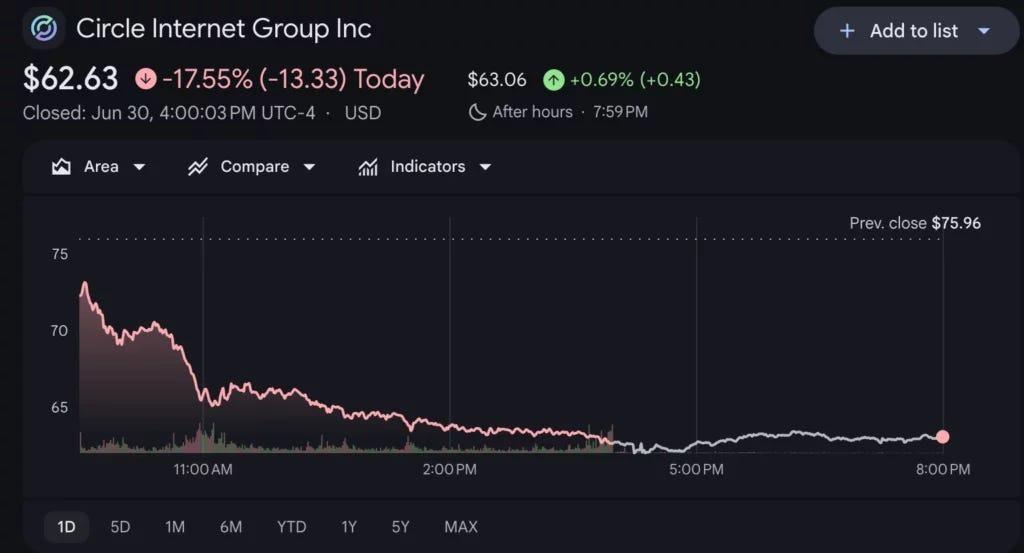
The issuers left out are already feeling it in the stock market. Circle, the publicly traded face of stablecoins, watched its shares drop 17.5 percent the same day OUSD launched. Some of that was mechanical. FTSE Russell’s semiannual index reconstitution booted Circle from several growth indexes that same week, forcing index funds to sell regardless of what they thought about the company. But strip that out, and the reaction to the OUSD news on its own still says something. The market is rethinking whether issuers get to keep hoarding this revenue forever.
Here is the thing though. How much liquidity OUSD can actually pull from Circle in the short term probably matters less than it looks like it does. Liquidity, trust, and years of regulatory standing are hard things to displace overnight. What is really spooking the market is something else, the idea that reserve revenue sharing itself is now up for renegotiation, and that happens to be exactly where Circle is weakest.
Look at Circle’s revenue mix and the fragility becomes obvious. This is a company almost entirely at the mercy of interest rates. In 2025, Circle pulled in 2.75 billion dollars in revenue, and nearly all of it came from interest on USDC’s reserves. Fourth quarter reserve income alone hit 733 million dollars, more than 95 percent of total revenue for the quarter. The mechanics are simple. Users park dollars in USDC, Circle buys short term Treasuries with that money, and the Treasury interest is basically the entire business.
Then there is the cost side, which is arguably worse. Coinbase keeps a hundred percent of the reserve income generated by USDC held on its own platform, and splits everything else fifty fifty, according to Circle’s IPO filings. In 2024 alone, that arrangement cost Circle 908 million dollars, more than half its total revenue, paid out to a partner that does not issue USDC and does not manage a single dollar of its reserves.
Circle cannot really do much about it either. The agreement cannot be cancelled unilaterally, and it renews automatically every three years, which leaves Circle with almost no leverage to renegotiate terms. Whatever happens to its margins going forward depends heavily on whether it can build real distribution outside of Coinbase, something it has not managed to do yet.
Put that all together and OUSD’s real threat comes into focus. The goal here is to take the reserve income that used to sit with issuers and hand it to whoever actually owns the transaction flow. A partner list this strong, plus Stripe’s enormous product footprint, gives that threat real teeth. Circle’s problem now goes well beyond defending USDC’s market share, it is whether Circle still gets to decide how reserve income gets split at all. Worth watching from here is whether Circle tries to renegotiate its distribution deals, and how the issuers and channels still sitting on the fence end up responding.
So, Can OUSD Actually Pull This Off
OUSD’s biggest asset is its distribution network and its on ramp and off ramp muscle, and that is also exactly the piece stablecoins need to finally break into mainstream payments. Whether that advantage turns into anything real depends on whether these channels actually move real business, default settlement paths, merchant acquiring, cross border treasury pools, onto the new system. On that front, there is still no clear answer. Reserve asset allocation, cross regional liquidity, compliance across a dozen jurisdictions, all of it is still being worked out.
The more interesting wrinkle is what is happening inside the alliance itself. Coinbase is still deeply invested in the USDC ecosystem and profits handsomely from it, yet it signed on to OUSD as a founding member anyway. That single fact might matter more than the entire 140 company roster. Why? Because Coinbase’s revenue sharing deal with Circle comes up for its first three year renewal in August 2026, less than two months after OUSD’s launch. That timing is not subtle. It looks a lot like Coinbase handing itself a bargaining chip right before sitting down at the negotiating table. Big distributors clearly are not interested in betting on a single stablecoin. What they actually want is leverage, the ability to play issuers off each other.
Whether OUSD ever reaches real scale comes down to one question, whether participants actually redirect meaningful volume or just keep hedging across multiple stablecoins without fully committing to any of them. Nobody can answer that yet.
But here is what is already true regardless of how OUSD turns out. This alliance just broke an assumption that has held for years, that reserve income naturally belongs to the issuer. It never had to work that way, that is just how the market happened to settle. Seen through that lens, Open Standard looks less like crypto’s usual brand of decentralization and more like decentralizing the business itself, pushing the spread that Circle and Tether used to pocket toward the platforms that actually generate the volume and hold the balances. The center has not gone away. It is just that the issuer is no longer the only obvious place for that money to land.