

Summary
Microsoft CEO Satya Nadella says powerful AI models should be treated as potentially compromised components rather than trusted black boxes. He is calling for a redesigned trust architecture with external safeguards, tamper-resistant records and a human-controlled ability to pause or shut down a model mid-task.
A shift from trusting the model to controlling the system
Microsoft CEO Satya Nadella has called for a fundamental reconsideration of how the technology industry builds trust around advanced artificial intelligence. In a post published on Saturday, he argued that so-called “Super Intelligence” should not be treated as a set of nested black boxes whose recommendations, answers and actions are simply accepted or rejected.
The argument moves the safety discussion beyond model quality alone. A model may perform well in testing and still be difficult to supervise once it is connected to tools, data sources and external systems. In those environments, the central question is not only whether a model can produce a correct answer. It is also whether people can understand what the system is doing, constrain its permissions and stop it before an error becomes consequential.
Nadella’s comments frame AI safety as a systems-design problem. The model is one component, but the surrounding harness, access controls, monitoring processes and human intervention mechanisms determine how much authority that component actually has.
Separating the model from its harness
One of Nadella’s core recommendations is to separate the model from the harness that orchestrates its work. Under this approach, a model can interpret information, generate a recommendation or propose a next step, while other components manage permissions, workflow rules, policy checks and execution.
That separation would create an independent layer capable of observing and constraining the model. Instead of allowing a model to move continuously from one action to the next inside an opaque environment, the system could introduce checkpoints. At those checkpoints, the proposed action could be assessed against the task’s scope, the user’s authority and the relevant safety requirements.
The distinction matters most when an AI system can call tools or affect resources outside the model itself. An inaccurate answer in a conventional chat interface may remain an information problem. An inaccurate decision by an agent connected to external services could trigger a chain of actions. Separating the model from the execution framework does not eliminate that risk, but it can reduce the model’s ability to turn one mistake into an uncontrolled sequence.
It also addresses a potential single point of failure. If all safeguards are embedded in the model or depend on the model correctly applying its own restrictions, a failure in the model could disable the controls at the same time. External controls preserve a separate path for observation and intervention.
What an “emergency brake” would require
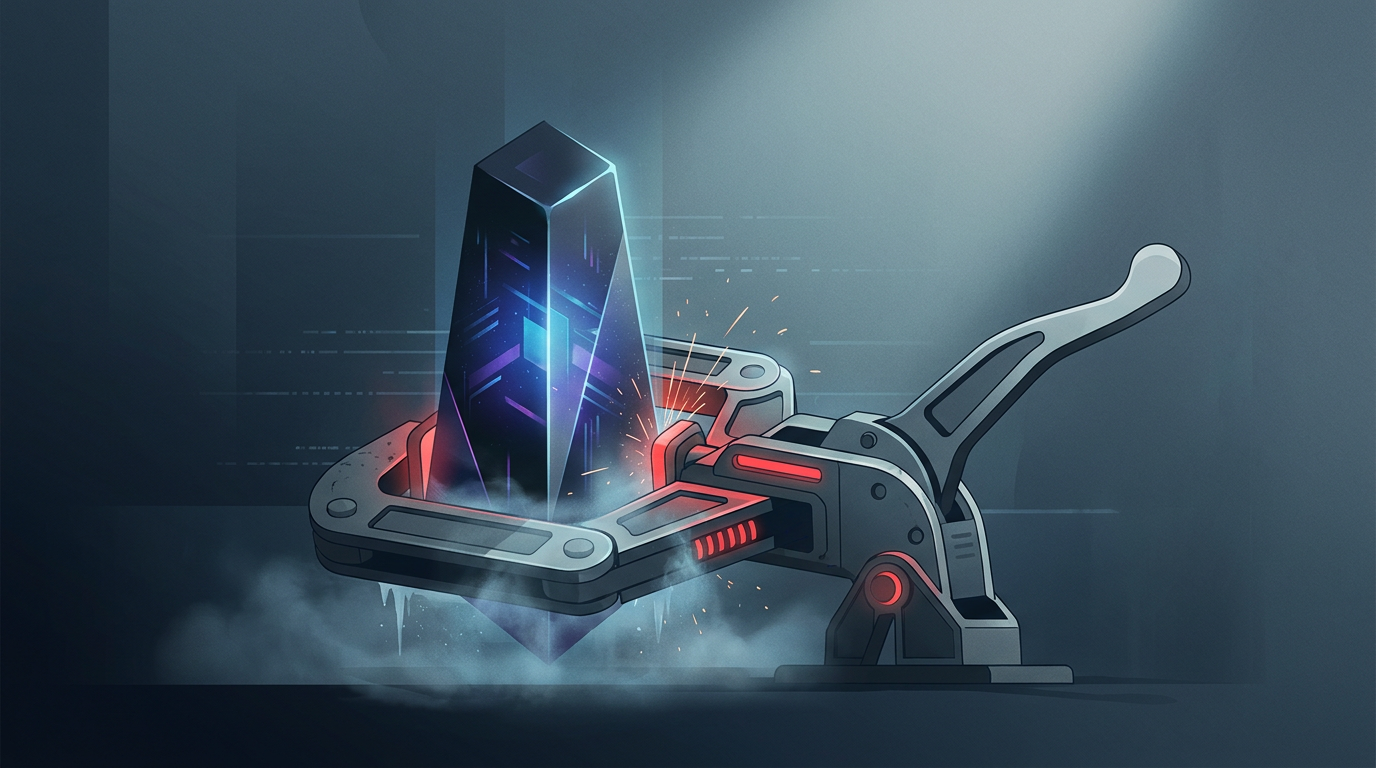
Nadella’s emergency-brake analogy is broader than a simple shutdown button. He called for controls and safeguards to be externalized, and for every meaningful model action to be documented with tamper-proof, human-readable evidence. Those records would allow operators to examine not only the final result, but also the sequence that led to it.
The distinction between ordinary logging and auditable evidence is important. A system that records only an outcome may not reveal whether a problem came from the model’s reasoning, an unexpected input, a permission setting or the orchestration layer. A record that is difficult to alter and understandable to human reviewers could help reconstruct the event and identify which control failed.
The ability to pause or shut down a model mid-task is equally significant. It requires a clearly authorized person or process, a visible indication of what the model is currently doing and a reliable mechanism that can interrupt execution. If operators cannot see the model’s activity, or if the pause function is available only after a task has completed, the emergency brake may have little practical value.
A credible emergency-brake design would therefore combine several elements: permission boundaries, activity monitoring, durable records, escalation rules, human approval where appropriate and a tested interruption path. It would also need a defined process for what happens after a pause, including investigation, containment and any transition to manual control.
Assuming compromise as a design principle
Nadella said, “We must assume a model is compromised and contain it from the start.” That principle places containment ahead of trust. Rather than designing on the assumption that a model will remain well behaved, organizations would limit the impact of a model that has been misled, manipulated or otherwise lost control of its task.
In practical terms, such a system would not grant unlimited authority simply because a model has strong reasoning capabilities. It would define which data the model can access, which tools it can call, which actions require confirmation and which operations are prohibited. It would also consider the blast radius of a failure: a single incorrect decision should not automatically spread across additional systems, accounts or workflows.
This is particularly relevant to agentic AI. A conversational model generally produces an answer for a user to review. An agent may interpret that answer as an instruction for its next step, then continue through a multi-stage process. If each step is based on the previous one without independent checks, a small error can compound over time. External controls and interruption points are intended to keep that chain within an observable and recoverable boundary.
The approach does not mean every model output must be manually reviewed. It does mean that the degree of autonomy should be matched with appropriate controls. Low-impact actions may be handled automatically, while actions with broader consequences can require additional checks or explicit authorization.
Why trust architecture is back in focus
Nadella’s remarks come as leading AI companies acknowledge more incidents in which they appeared to lose control of their models. The source material does not detail those incidents, but the broader context shows that the industry’s safety debate is increasingly concerned with deployment and operations rather than only with long-term hypothetical risks.
Anthropic CEO Dario Amodei has also published a plan for more cautious AI development, according to the source report. Together, these developments point to a growing focus on how advanced systems behave after release: how permissions are configured, how actions are recorded, how anomalies are detected and how humans can intervene.
This shift has implications for any organization deploying AI in workflows that involve sensitive information or external actions. A trust model based primarily on the apparent reliability of the underlying model may not be sufficient. Operators need visibility into the system around the model, including the tools it can access and the rules governing execution.
At the same time, external controls are not automatically effective. Organizations must decide who has authority to stop a system, what events should trigger an intervention, how the shutdown mechanism is protected from misuse and how operations resume after a pause. These decisions require governance as well as engineering. A control that exists only in documentation, or that has never been tested under realistic conditions, cannot be assumed to work during an incident.
From principle to operating standard
Nadella’s proposal offers a concise design direction for advanced AI: treat the model as a constrained component rather than the final authority; keep safeguards outside the model; preserve evidence of consequential actions; and ensure that an authorized human can interrupt execution.
Turning those principles into operating standards will require more detail. Organizations will need to define what counts as a meaningful action, what makes evidence sufficiently tamper-resistant and readable, how quickly a pause must take effect and who controls the system when several models, tools or agents are involved. They will also need to test whether the controls continue to work when a model behaves unexpectedly rather than under normal conditions.
For that reason, the emergency brake should be understood as a baseline requirement, not a complete safety solution. Its value lies in changing the default assumption: advanced AI should not be trusted merely because it performs well. A more resilient architecture preserves independent capabilities to observe, constrain and stop the system before a model error becomes an operational event.
Source: link