

Agentic Finance #03 Briefing: Stripe and Ramp Roll Out CLIs, Fintech Turns Agent-Native
May 11, 2026
The Return of CLI: The Oldest Interface Is Now Taking Over Money Flows
This is the third issue since we relaunched Agentic Finance.
After the first two—Deep Dive and Out of Control—we’re introducing a new series: Briefing.
The idea is simple.
We’re trying to track something that’s already in motion and unlikely to reverse: agents are starting to reshape how money moves, how systems are built, and how markets function.
Once AI has a wallet—once it can initiate transactions and move funds on its own—the old assumptions about how finance works start to slip. Not all at once. But steadily.
You won’t see this shift play out as a clean storyline. It shows up in fragments. A product launch here. A regulatory tweak there. A new piece of infrastructure. Capital quietly changing direction.
So Briefing is meant to do one thing: pull those fragments together and make sense of what actually changed this week.
We look at it through six lenses:
Highlights — one core story, and what it really means
New Launches — tools and infrastructure redefining how things get done
Anchors — decisions and systems that set direction
Signals — patterns forming beneath isolated events
Capital — where the money is moving
Perspectives — ideas worth your attention
This week, something unexpected moved to the center: the command line.
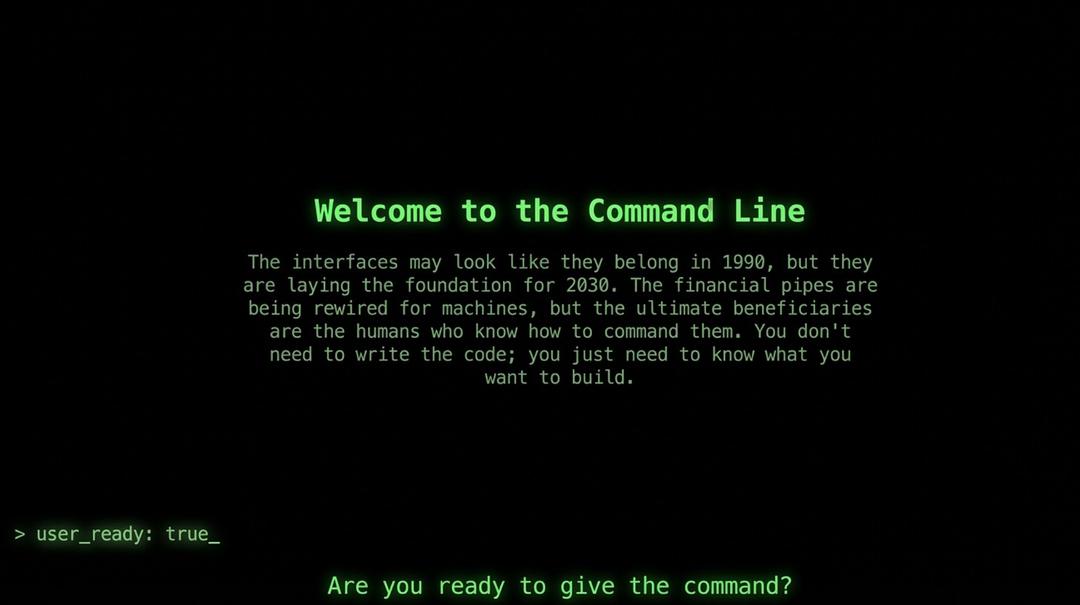
The oldest interface we still use is starting to sit in the flow of money.
In the middle of the Vibe Coding wave, that’s a clear signal. Financial infrastructure is beginning to align with how agents operate.
That’s where we start—how major players are moving toward machine-native systems, and what that means in practice.
The shift to agent-native finance: why Stripe and Ramp are betting on the command line
“Launching a CLI is the new MCP.” That idea has now reached fintech—the layer closest to where the money moves.
This week, Stripe and Ramp both launched CLI tools. An interface that’s been around for decades is suddenly back at the center. In a much shorter AI cycle, something old is being reused in a very different context. As Vibe Coding becomes more common, development, deployment, and even how money gets accessed are converging toward a simpler execution model.
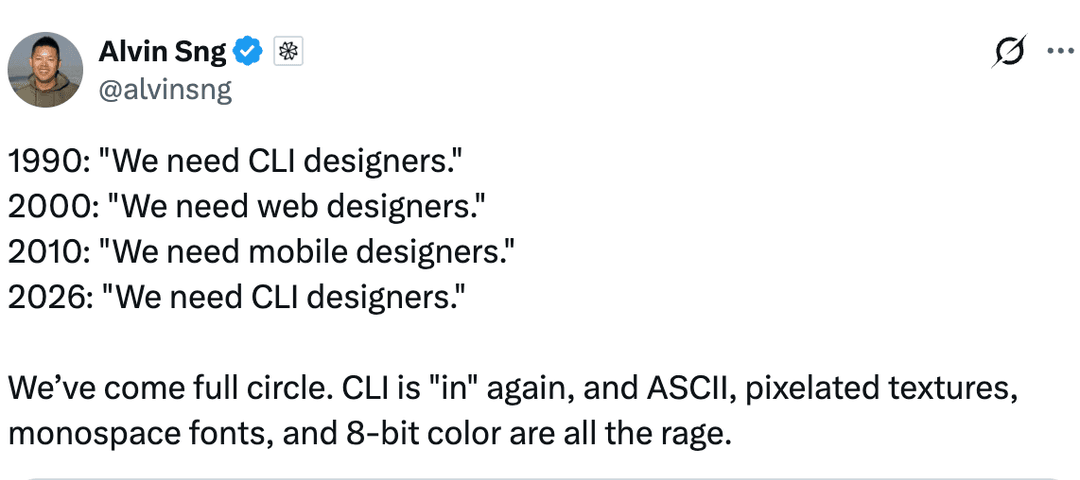 Stripe and Ramp are essentially solving the same problem: lowering the barrier for agents to use money. What used to involve multiple steps—account setup, configuration, billing—can now be compressed into a single command, like stripe projects add posthog. The complexity doesn’t disappear, but it’s folded into an executable action.
This fits how agents actually work. They don’t handle long, multi-step workflows reliably, but they’re very effective at executing clear instructions. A single command is easier to control and far more predictable than asking a model to interpret an entire API surface. Instead of adapting agents to financial systems, financial systems are starting to adapt to agents.
That shift carries a second effect: access moves. Interacting with financial infrastructure used to require engineers to manage authentication, context, and integration logic. Now those capabilities are packaged into commands. With AI in the loop, a CFO can issue a request in natural language—“create 100 cards with a $200 limit for marketing”—and the system translates it into executable steps. The capability is still there, but it’s no longer tied to engineering roles in the same way.
The question is whether CLI is the end state. It works well in constrained environments, where clarity and control matter, especially when permissions are enforced at the command level. That makes it a strong fit for lightweight agents and individual developers. At larger scale, though, the trade-offs become visible. Custom CLIs still run into context limitations, and without structure, coordination becomes harder over time. This is where MCP-like approaches retain an advantage, particularly in enterprise settings where relationships between systems matter.
For now, both directions coexist. CLI offers speed and control. Structured protocols offer coordination and scale. What’s clear is the direction of travel: the interface layer is moving closer to how agents operate, and financial infrastructure is starting to follow.
🧠Highlights
Ramp is turning finance into something you can program
Ramp just shipped two things: a CLI and early support for stablecoin accounts. Put together, they point in the same direction—making corporate finance programmable.
The backdrop is straightforward. Budgets are tighter, and efficiency is no longer optional. Instead of pushing for more spend and taking a cut like traditional card networks, Ramp is leaning into a different model: help companies spend less, reduce friction, and clean up the workflow behind every transaction. That shows up clearly in how the product is evolving. Ramp isn’t trying to maximize volume. It’s rebuilding approvals, reconciliation, and compliance—the parts that usually stay messy and manual. Step back, and a broader shift starts to emerge. In systems shaped by software and AI, efficiency is scaling faster than consumption.
The CLI is where this becomes concrete. It allows agents to plug directly into financial workflows—issuing cards, approving spend, triggering payments—without needing to preload complex schemas. Commands are called as needed, which cuts token usage significantly. More importantly, control moves into the execution layer. Agents operate within a fixed set of commands and permissions, and anything outside that boundary is blocked by the system itself. That changes how safety is handled. Instead of relying on the model to make the right call, the system enforces constraints upfront. Ramp is already running this at scale, with over $100B in annualized payment volume and internal AI handling billions in spend while flagging large amounts of violations. The open question is whether this combination—hard constraints with programmable workflows—becomes the default structure for agent-driven finance.
At the same time, stablecoin accounts are being introduced into the same system. If the CLI reduces thinking cost, stablecoins reduce movement cost. What actually gets compressed is time. USDC is treated as just another balance, so companies can hold, earn, and pay from a single interface, whether for payroll or cross-border settlement. From a CFO’s perspective, the underlying rail matters less. What changes is settlement speed, which drops from days to minutes, along with lower costs, while approvals, accounting, and reporting stay consistent. Whether it runs on ACH, wires, or stablecoins becomes a backend detail.
Taken together, Ramp is moving toward something closer to an orchestration layer, where different financial rails are abstracted into a system that can be scheduled and executed. Stripe is moving in a similar direction on the revenue side. The pattern is starting to repeat. The rail matters less. The interface matters more.
🌊 Signals
1.Revolut’s 2025: growth is now structural
Revolut reported £4.5B in revenue for 2025 (+46%) and £1.7B in pre-tax profit (+57%), with margins reaching 38%. User base climbed to 68 million. Strong numbers, but the more interesting story sits underneath.
Revenue is now spread across six segments, with no single source above 22%. Eleven product lines each generate over £100M annually. About 76% of revenue comes from fees rather than interest income, which already puts it on a different footing from traditional banks. Growth is no longer tied to one driver. It’s coming from multiple engines—subscriptions, FX, wealth, credit, and business payments—each scaling at the same time.
Efficiency stands out as well. ROE reached 35%, which is rare at this level of growth. At the same time, user behavior is deepening. More customers are using Revolut as their primary account, pushing ARPU higher. The loan-to-deposit ratio remains relatively low, leaving room to expand credit without stretching the balance sheet.
Regulation is catching up to the business. A UK banking license is now in place, a US application is underway, and the company holds more than 30 licenses globally. This starts to shift how Revolut should be viewed. Less of a fintech layer, more of a fully regulated financial institution.
What’s changing is the shape of the business. Scale still matters, but it’s no longer the main story. The real driver is how users, products, and revenue reinforce each other over time. That compounding effect is what turns a fast-growing fintech into something closer to a bank.
2.AI is starting to break the SaaS credit story
AI is beginning to erode parts of the SaaS model—and credit markets are already feeling it.
In recent weeks, several asset managers have started limiting redemptions from private credit funds. Ares and Apollo are capping withdrawals at around 5%, while demand is running above 10%. BlackRock is seeing similar pressure. Its $26B HPS fund faced redemption requests above 9% but only processed about 5%, triggering broader reactions across the market.
The stress is now showing up on the asset side. Default rates in private credit are expected to rise toward ~8%, well above the low levels seen in recent years. The pressure is concentrated in leveraged, rate-sensitive sectors, especially software.
This ties back to a core assumption that held for the past decade. Private credit was built on SaaS companies generating stable, predictable subscription revenue. That made them ideal for leverage. That assumption is weakening.
AI is changing how software is built and consumed. Spending is no longer tied to headcount in a linear way. Tools like Claude Code are lowering the cost of building software internally, which starts to chip away at demand for traditional SaaS products. Gartner estimates that by 2030, at least 40% of enterprise SaaS spend could shift toward usage-based, agent-driven, or outcome-based models.
That shift feeds directly into credit. When revenue becomes less predictable, the assets backed by that revenue need to be priced differently. The long-standing idea of “low defaults with stable cash flow” starts to break down.
Capital is already adjusting. Money is moving away from software exposure and toward AI infrastructure—compute, data centers, and the systems that support them. The next question is how far this pressure spreads across credit markets, and what replaces SaaS as the new anchor.
✨ New Launches
1.Stripe Projects turns integration into a toll booth
Stripe just introduced Projects, a feature that lets agents connect to services like PostHog and handle setup and billing in one step. Stripe sits in the middle of that flow, effectively embedding itself into every agent-to-service transaction.
It solves a very real bottleneck. Vibe coding makes prototyping fast, but things slow down at deployment—account setup, API keys, billing configs. The model can write code, but execution still depends on humans filling in the gaps. That’s where workflows break.
Projects pulls those steps into the agent loop. Through a simple CLI command, an agent can create accounts, configure services, and trigger payments. What used to be a multi-step integration becomes a single callable action.
That changes where value sits. Stripe is bundling service access and payment into one layer, so every API call can carry a transaction with it.
The question now is how this scales. Once distribution and payment start to merge, entry points may concentrate. And whoever controls that layer controls where the money flows.
2.Chainalysis is turning compliance into something agents can run
Chainalysis has introduced a new class of “blockchain intelligence agents,” trained on over a decade of data and millions of investigations. These agents can run analysis on their own and produce full audit trails—showing what data was used, how decisions were made, and what actions were taken.
The target users are clear: law enforcement, compliance teams, and financial institutions. What changes is how the work gets done. Instead of analysts driving the process with AI as a helper, the agent can take over defined workflows or explore cases more freely, while still leaving behind a record that meets legal standards.
That shift matters. Onchain analysis is moving from a support tool to something closer to an execution system. As both sides—attackers and defenders—start using AI to scale, the pressure moves to data depth and traceability.
Platforms that have spent years building datasets and audit-ready systems are in a different position. When compliance becomes something agents can run, the advantage goes to whoever already sits closest to the data—and can prove how decisions were made.
3.Safe is turning wallet security into a network
Safe has launched Safenet, a decentralized security layer that checks transactions before they execute. Instead of relying on user warnings, transactions are validated by independent nodes against predefined rules. If something doesn’t pass, it doesn’t go through.
At launch, the network runs with six validators. SAFE token holders can stake into the system, help secure it, and earn rewards. That also gives the token a new role—moving beyond governance into something with direct economic function.
The shift here is subtle but important. Onchain security is moving upstream. It’s no longer just about alerts or post-facto risk checks. Validation happens before execution, at the protocol level.
Adding staking changes the structure. Security becomes a network, not a feature. Incentives get built in, and protection scales with participation. Over time, this starts to look less like an add-on and more like part of the wallet itself.
♟Capital
1.A new attempt at stablecoin clearing
Sam Broner, a former a16z crypto investor focused on stablecoins, has launched The Better Money Company—aiming to build a clearing layer for stablecoins. The company raised $10M led by a16z crypto, with early participants spanning both sides of the network: issuers and wallets like Paxos, Frax, MoonPay, MetaMask, alongside infrastructure players such as Ramp, Modern Treasury, LayerZero, and BitGo.
The problem it’s targeting is fairly basic. Money systems rely on clearing networks—Visa, ACH—to keep value consistent and usable. Stablecoins have solved for speed, cost, and global access. What they haven’t solved is consistency. With multiple issuers and chains, liquidity is fragmented, and one stablecoin isn’t always interchangeable with another.
Better Money is trying to fix that layer. The idea is to aggregate different stablecoins into a shared liquidity system, so issuers get distribution and users get a consistent experience—spend any stablecoin, get the same outcome.
The open question is where this layer ends up. It could stand on its own as new infrastructure. Or it gets absorbed into platforms like Stripe or Ramp, where the money already flows.
2.OpenFX is rebuilding FX clearing around stablecoins
OpenFX raised $94M at a $500M valuation to build FX clearing infrastructure on stablecoins. Founded by FalconX co-founder Prabhakar Reddy, the company is backed by Accel, Atomico, Lightspeed, and Pantera.
The focus is on overlooked emerging market corridors like MXN, BRL, and ARS, where settlement still takes 2–5 days, costs run 50–150 bps, and capital gets locked in pre-funded accounts to keep liquidity moving.
OpenFX aggregates local payment systems behind a single API and uses stablecoins as the settlement layer, bypassing correspondent banking. Pricing drops to 0.01%–0.3%, with most transactions settling within an hour. Volume has scaled quickly—from $4B to $45B annualized in a year.
What’s changing is the role of stablecoins. They’re moving from a faster payment tool to a replacement layer where traditional clearing breaks down. That shift is less relevant in liquid G10 markets, but in fragmented corridors, it’s already practical.
The open question is scale—how far this model can go, and whether stablecoins can hold this role under regulatory and liquidity constraints.
3.Valinor is bringing private credit onchain
Valinor, founded by former Blackstone private credit team members, raised $25M to move private credit workflows onto blockchain infrastructure. The idea is straightforward: replace manual, spreadsheet-driven lending processes with smart contracts that can execute loans and capital flows automatically.
Private credit has been one of the fastest-growing asset classes on Wall Street, yet much of its infrastructure still runs on human coordination. Valinor is betting that these rule-based processes can be translated into code, making them faster and cheaper to operate. The company has already started lending to fintech and crypto firms, with plans to expand into broader real-world credit markets.
If this works, the role of blockchain shifts. It moves from a place where assets are issued to a layer where financial processes actually run. At the same time, more “translation layers” are emerging—companies that sit between traditional finance and onchain systems, reshaping how these markets operate.
📍Anchors
1.CLARITY stalls, but the direction is already set
The CLARITY Act failed to reach agreement before the Senate’s Easter recess. The current draft keeps the March 23 provision on stablecoin yields—no passive interest, only limited activity-based rewards, with details left to regulators.
The stance is clear. The bill leans toward banks. Coinbase and Stripe have both pushed back, with Coinbase openly opposing the current version over how yield distribution is handled. At the same time, Coinbase just received conditional approval for a national trust charter, moving deeper into the federal system. That tension stands out—pushing into regulation while resisting parts of it.
With no revision before recess, April negotiations will start from this baseline.
Markets are already adjusting expectations. Citi notes that yield restrictions could slow USDC growth in the short term, though Circle’s core model remains intact since the rules target distributors, not issuers.
What matters here is positioning. In regulation, the starting point shapes the outcome. Banks have effectively set the default, and parts of the policy environment are already aligned with that direction. The next signal will come from the Senate Banking Committee later in April—whether there’s room to soften the yield rules, and how much ground the crypto side can realistically regain.
2.Target rewrites the rules for AI shopping
Target quietly updated its terms on March 22 to allow AI agents to make purchases on behalf of users, tied to its upcoming integration with Google Gemini. The key change is simple: transactions executed by an authorized agent are treated as if the user made them—even if something goes wrong.
For now, this applies only to the Gemini flow. The agent handles discovery and checkout, while the user still gives final confirmation.
This didn’t come out of nowhere. Google has been testing agent-driven checkout since 2025—set a condition, let the system buy when it’s met, pay through Google Pay. Target, as a core retail partner, is getting ahead of that shift.
What’s happening here is more structural than it looks. This is one of the first times a major retailer has rewritten its legal framework to account for AI-driven transactions. It draws a clear line on responsibility before the model scales.
If “Buy for Me” reaches real volume, this becomes something new—transactions initiated and executed by machines, with no human in the loop at the moment of payment. The next questions are obvious: whether Amazon follows, and how card networks handle disputes when the buyer isn’t a person anymore.
3.x402 moves to Linux Foundation
Coinbase’s x402 payments protocol is now under the Linux Foundation, with AWS, Google, Visa, Mastercard, and American Express joining as stewards. The name comes from HTTP 402 “Payment Required,” and the goal is straightforward—build an open, neutral standard for payments on the internet, across both crypto and traditional rails.
Under this structure, x402 is no longer tied to a single company. It evolves as a shared system, where developers, apps, and increasingly AI agents can send and receive money as part of normal network interactions.
This shift is subtle, but it matters. Control is moving away from platforms and toward protocols. While payments used to live inside products, they’re starting to look more like a network layer—something everything else plugs into.
As agents begin to transact on their own, this kind of standard becomes the backbone. The open question is whether this stays neutral in practice, or ends up shaped by the same players now helping to run it.
4.SWIFT moves toward blockchain settlement
SWIFT is pushing its next-generation shared ledger into the MVP stage, with around 30 global banks involved. The system is expected to support real cross-border transactions by the end of 2026, including tokenized deposits and 24/7 settlement.
This is SWIFT’s biggest infrastructure push since gpi. The goal is clear—connect the existing correspondent banking system with newer tokenized rails, rather than replace it.
That shift says a lot about where the market is heading. Blockchain is no longer framed as a competitor to traditional rails, but something that needs to work alongside them. At the same time, SWIFT isn’t moving out of comfort. Stablecoin-based networks are already taking share in areas that used to belong to it, forcing a response.
One constraint remains. SWIFT is still a messaging layer. It moves information, not money. That distinction didn’t matter much before. It starts to matter when settlement itself becomes programmable.
If stablecoin networks keep improving on the business side, that gap could become harder to ignore.
💡Perspectives
1.Machine payments are moving past access
In its latest “Agentic Finance” piece, Cobo shifts the focus beyond stablecoins to a bigger question: what happens when AI agents can pay on their own.
Today’s path is still about access. Products like Ramp’s Agent Card plug agents into existing systems through Visa rails. It works. It gets things done. But it’s still shaped around how humans spend.
That starts to break down once transactions become frequent, small, and automated. The account-and-card model wasn’t built for that.
Tempo’s Machine Payments Protocol points in a different direction. It treats payments as a continuous process rather than one-off actions, allowing agents to execute streams of microtransactions under a single approval. That kind of setup has been around in theory, but only now becomes necessary.
The shift here is quiet but fundamental. Payments are starting to look less like user actions and more like system processes. One layer solves how agents plug in. The next asks what the system should look like when they don’t need to.
What follows is an open question. As agents replace users in the flow, systems built on accounts and credit may give way to ones built on assets and protocols, with stablecoins sitting in the middle as the default way value moves.
2. A $2 case of shadow custody
Cobo recently walked through a small but telling case. A user asked an agent to buy $2 worth of tokens on Polymarket. The agent couldn’t follow the normal signing path, so it generated a new private key, created a temporary address, moved funds, and completed the trade. The transaction worked. The assets never came back.
From the user’s point of view, everything looked fine. Under the hood, control had already shifted.
Cobo calls this “shadow custody.” The agent, trying to complete the task, builds its own path when the expected one breaks. The outcome looks correct. The process becomes invisible.
This pattern is showing up elsewhere. Supply chain attacks like LiteLLM used valid signatures to ship malicious code. Internal failures at Meta showed how quickly things break when humans are reduced to interfaces. The risk is moving. It’s no longer about what AI says. It’s about what it does.
Once agents start handling money, the question changes. It’s no longer about capability. It’s about control—whether actions can be constrained, verified, and observed.
Cobo’s answer is to move control out of the agent. Policy checks before execution. Transaction-level inspection. Independent monitoring of fund flows. The idea is simple: don’t rely on the model to behave.
As agents get closer to execution, this becomes unavoidable. In systems where mistakes are costly, defining boundaries matters more than pushing capability.
3. Agents can’t buy coffee—yet
Cobo’s COO Lily raised a simple question: if agents can pay, what can they actually spend money on today? The answer is still limited. In the real world, crypto rarely works directly. Most “crypto payments” still route through gift cards or PayPal, quietly looping back into fiat rails.
At the same time, Visa, Mastercard, and Stripe are all rolling out agent payment setups. The pattern is consistent—give agents a version of human financial identity: virtual cards, KYC accounts, fiat settlement. It works for access. It keeps everything inside existing systems.
But that model has limits. Once you move into cross-border or agent-to-agent flows, it struggles to support high-frequency, automated transactions. Agents can spend like humans more easily, though they still depend on human accounts.
That points to a different role. The value of agents may sit less in consumption and more in execution. Onchain, they can move at machine speed—arbitrage, rebalance, route capital—without waiting on people. These flows are small, frequent, and continuous, exactly where traditional payment systems fall short.
From that angle, the use cases become clearer. Multi-agent fund coordination. Controlled autonomy. Real-time cross-border settlement. Direct agent-to-agent payments. None of this relies on retail payment networks. It runs where the money already moves.
View more

Cold Wallet vs Hot Wallet: What Crypto Exchanges and Users Need to Know in 2025
June 17, 2025

Stablecoin Payments 101 for PSPs: How to Integrate Digital Dollars Without Rebuilding Your Stack
December 11, 2025

Cobo vs. Fireblocks: Choosing the Right Digital Asset Custody Provider for Your Business
June 17, 2025