The Machine Economy Demands New Money: From Ramp's AI Agent Visa Cards to Tempo's Payment Protocol Rewrite
May 11, 2026
For the past year, Cobo's Stable Weekly has consistently delivered 36 issues.
Over these 36 editions, we've chronicled stablecoins' evolution from a crypto primitive to a tangible infrastructure. We've seen them move from regulatory exploration to scaled expansion, progressively integrating into real-world applications. Stablecoins are no longer just theoretical concepts; they are steadily embedding themselves into the existing economic system. Concurrently, Cobo has been actively iterating and practicing product development in the payment space along this very trajectory.
However, technological evolution is rarely linear.
Over the past few months, a significant shift has begun to emerge. With the rapid advancement of AI capabilities, Agents are transforming from mere information processing tools into active execution entities. They can now invoke services, coordinate resources, and even directly participate in payment processes.
This fundamentally means that our economic system is introducing a completely new class of participants.
In light of this change, we've decided to refine this weekly report, a publication we've sustained for a year.
Starting with this issue, Cobo's Stable Weekly will be officially renamed "Machine Finance." Our scope of focus will expand beyond stablecoins themselves to encompass the broader intersection of AI and payments. Whether it's card networks, Bitcoin, stablecoins, or wider financial technologies, we will frame our analysis around a central question: As Agents become the new consumer, how will payment systems evolve?
Correspondingly, our content format will also be adjusted. We will no longer adhere to a fixed weekly frequency. Instead, we will adopt a "bi-weekly digest + in-depth feature" model. In an era of information overload, we believe that providing structured, deep insights holds far greater value than frequent but fragmented updates. Our aspiration is to deliver truly thoughtful analysis at critical moments.
Today marks the inaugural issue of our revamped publication.
We will begin by exploring a core question: As machines start to pay autonomously, how will existing financial infrastructure respond?
This article will delve into two specific case studies: Ramp's provision of Visa cards for AI Agents, representing an interface-layer adaptation, and Tempo's attempts to re-architect underlying payment protocols. These two paths illustrate different directions in the evolution of payments within the machine economy.
Below.
The Machine Economy's Future, Converging on Stablecoins
Ramp’s recent deployment of its Agent Card, a virtual instrument for AI agents, unequivocally sends a clear signal: the widespread adoption of agent payments will not await the organic maturation of Web3 infrastructure. Rather, it will prioritize leveraging existing payment networks, establishing real-world utility by integrating with prevailing systems.
This trajectory is hardly surprising. Business operations typically gravitate towards the path of least resistance. New technologies, more often than not, become embedded within established networks before any wholesale attempt is made to construct entirely new systems. Agent payments are merely adhering to this well-trodden playbook.
Technically, the Agent Card is not a groundbreaking innovation. Its true strategic significance derives from a shrewd business decision: it enables agents to directly access the Visa network. This allows for immediate procurement and settlement across the entirety of the existing merchant base, circumventing any dependency on merchant-side system upgrades.
This aligns closely with Cobo’s analysis in their " 2025 Stablecoin Review and Outlook," which posited that until stablecoin acceptance achieves significant scale, card networks will remain the primary conduit for digital assets to permeate the real economy. The translation of technical capability into practical application invariably hinges on infrastructure readiness.
Yet, a critical distinction must be drawn: this represents a temporary bridge, not the ultimate destination.
Ramp addresses an immediate, pragmatic concern: "How do we enable agents to execute payments within the current system?" The core objective is integration, ensuring agents can function within today's commercial environment. The subsequent phase, however, will fundamentally reorient the focus: "How do payments occur in a manner native to machines?"
Presently, agent payments largely emulate human consumer behavior. But in authentic Machine-to-Machine (M2M) scenarios, this model encounters a decisive impasse. Consider transactions executing in seconds, for mere cents, while settlement cycles remain protracted (days) and fees constitute a fixed percentage. Such a system would rapidly collapse. Traditional interface capabilities are inherently insufficient to meet the stringent demands of machine payments. What is required is a fundamental restructuring of the underlying financial plumbing.
It is precisely into this context that Tempo’s newly introduced Machine Payments Protocol (MPP) steps, presenting as a highly significant development. It aims to redefine the very primitives of machine payments. Instead of payments functioning as discrete "events," MPP seeks to embed them directly into continuous machine processes, transforming them into a steady "stream." This environment is precisely where native digital assets, particularly stablecoins, can genuinely realize their inherent advantages.
Thus, Ramp and MPP can be viewed as representing two distinct chapters. Ramp facilitates agents' entry into the existing commercial world. MPP, conversely, is exploring the inherent mechanics of payment within a machine's own language—a truly native payment world, requiring no translation, and operating at machine speed.
Cutting the Friction of Human Approvals
The expansion of AI capabilities is self-evident. Agents, once confined to processing information, are now evolving into active executors. They are increasingly shouldering routine, transactional tasks traditionally handled by humans: flight reservations, domain acquisitions, software subscription renewals—even the initiation of payments.
Yet, a critical impediment persists: this transition invariably encounters human bottlenecks at crucial junctures.
Within current systems, payment authorization typically remains a human prerogative. An agent engaged in its assigned duties must pause, issue a request for approval, and then await a human decision. Such interruptions anchor the efficiency ceiling of ostensibly autonomous workflows precisely to the speed of human response, underscoring their continued reliance on human judgment at critical points.
One might instinctively propose equipping the agent with existing payment instruments, such as a credit card. While this approach offers immediate implementation simplicity, it simultaneously engenders a new, significant problem: the conferral of payment authority without a commensurate control mechanism. An agent could then proceed to initiate transactions arbitrarily, at any time or in any context. The system itself lacks the granular means to impose meaningful constraints.
Precedent already illustrates the consequences. Consider the OpenClaw agent that, for instance, incurred approximately $3,000 in unauthorized expenditure on domains and courses. The fundamental issue lay not in malicious intent, but in the absence of clearly defined behavioral boundaries within the system design.
Evidently, if an agent is to function as a true executor, it requires dual capabilities. It necessitates the ability to process payments, inherently, to accomplish tasks. Equally vital, it requires the ability to operate within established rules. The former enables task completion; the latter confers trustworthiness.
Credit Cards, Now an API
Ramp’s approach here serves as a direct response to that very problem, fundamentally reshaping the expression of payment authority.
Dispense with the notion of a credit card as a perpetually held physical artifact. In this model, it functions as an interface capability, generated on demand. An agent does not directly access a physical card number. Instead, upon requiring a transaction, it queries an API to acquire a virtual credential. This credential arrives imbued with explicit constraints. Its validity is contingent upon specific conditions, and it expires precisely when the associated task concludes.
The true ingenuity of this design lies in its pre-emptive shift of control. A payment action is constrained by predefined rules before it can even materialize. A card can be delimited to specific merchants. Spending limits can be granularly tied to the exact task at hand. Even the usage window can be stringently defined. Crucially, these rules are embedded directly into the system's core logic.
From a system design perspective, this exemplifies classic "control pre-positioning." The agent’s behavior is not reliant on post-facto audits and corrections. It operates consistently within established parameters. Consider it analogous to a newly onboarded junior employee, whose scope of action is rigorously circumscribed and entirely pre-defined by the system.
The Financial System Adapts to Non-Human Participants
Consider the projections: Barclays anticipates 22 billion AI agents in the future. Gartner forecasts agentic AI to capture nearly 30% of enterprise software revenue by 2035. McKinsey suggests these software entities will command over a trillion dollars in spending by 2030.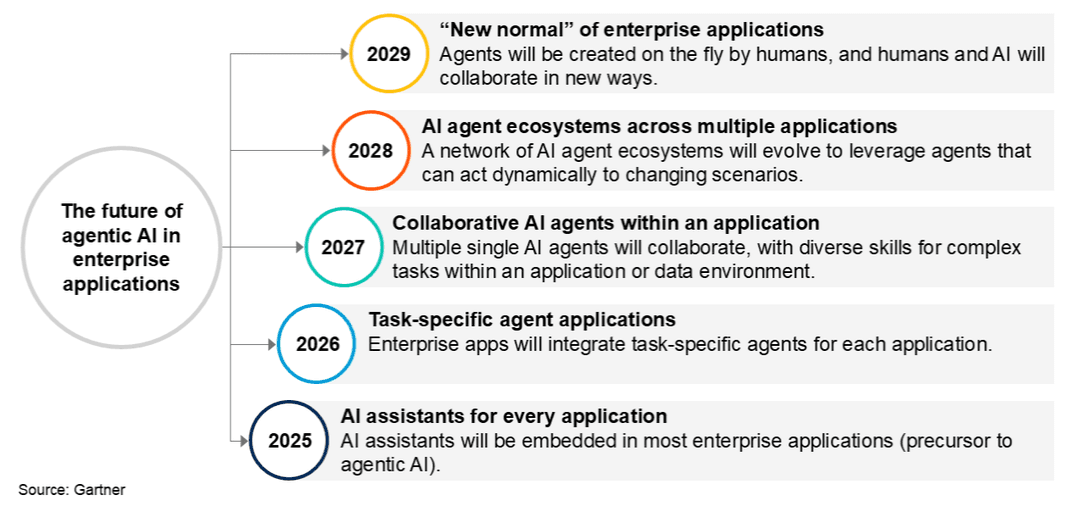 These forecasts converge on a singular conclusion: AI agents are transitioning into tangible economic participants. Humans will no longer be the exclusive transacting entities. These agents will autonomously manage budgets, invoke services, execute procurement, and finalize payments. For enterprises, as agent populations expand, their transaction volume could routinely eclipse that of human employees. This will constitute the new operational norm.
Against this backdrop, Ramp’s collaboration with Visa on virtual cards carries significant weight. It unequivocally signals that mainstream payment networks are commencing the build-out of infrastructure for "non-human transaction initiators." If machines become the predominant new consumer base, equipping them with controllable payment capabilities is an inevitable component of financial system evolution.
However, the inherent friction lies in this: the existing financial system is predicated on the assumption that transactions originate from a person. Identity verification, credit assessment, and authorization—all revolve around human agency. When the executing entity shifts to an AI agent, this fundamental premise begins to erode. An agent lacks a traditional identity; it does not rely on trust in the human sense. Its function is solely to execute pre-set instructions and rules.
Consequently, the very nature of payment undergoes a profound transformation. It evolves from a social act into a computational process. Each transaction, at its core, becomes a conditional check: "Are these specific conditions met?" The validation target shifts from "who is this person?" to "does this action adhere to the rules?" The method of verification migrates from human judgment to programmatic execution.
Ramp’s approach distinctly embodies this shift. By tokenizing each transaction, they disaggregate broad credit authorization into a series of discrete, ephemeral permission units. A traditional credit card represents a continuously open faucet of spending power. Here, "issuing a card" becomes an instantaneous, programmatic action. Each transaction is afforded its own tightly constrained payment credential. This "create-on-demand, destroy-after-use" mechanism rigorously adheres to the principle of least privilege. In high-frequency automated environments, by establishing boundaries upfront, it confines risk firmly within an acceptable range.
On a broader temporal scale, Ramp’s initiative constitutes merely one facet of a much larger trend. The Visa Trusted Agent Protocol and Intelligent Commerce Protocol—which Ramp leverages—demonstrate that traditional financial infrastructure is actively adapting to a novel participant: the "non-human entity." This marks a pivotal realignment for the financial system, transitioning from a human-centric to a progressively machine-centric paradigm.
Human Economy Limits vs. Machine Economy Physics
The changes we have discussed, while seemingly significant, remain fundamentally an adaptation at the "interface layer." Ramp’s strategy involves bolting a layer of programmable constraints onto the existing financial system, enabling AI to safely access payment capabilities within predetermined rules. Ostensibly, the system feels more "AI-native." Yet, beneath this surface, the underlying settlement network continues to operate on the same rhythms and foundational assumptions, all designed for human behavior.
This entire framework functioned perfectly within a human-centric economy. Transactions were infrequent, amounts relatively stable, and both delays and costs generally acceptable. However, when the transacting party shifts from a person to a machine, these unspoken assumptions rapidly dissolve. The critical question then becomes: can the entire structure genuinely support the entirely new patterns of machine behavior?
Transactions between machines are fundamentally distinct. They are characterized by high-frequency, granular value exchanges, deeply embedded within a continuous execution flow. A complex task is often decomposed into numerous sub-steps, each handled by different agents, and each step potentially involving a minute value transfer. This architectural pattern closely resembles data packets traversing a network, rather than a traditional consumer purchase. It telegraphs that the future of payments is not about occasional events; it is about systemic, constant flow.
It is precisely here that the traditional payment system's cost model first buckles under pressure. Fixed fees and percentage cuts, levied per transaction, are astronomically magnified in micro-payment, high-frequency scenarios. They quickly erode the already slender value of the transaction itself. Furthermore, settlement delay emerges as the second critical constraint. Machines operate continuously; there is no human-like gap between earning and spending. When funds require days to clear, the entire system grinds to a halt. The efficiency bottleneck ceases to be processing power; it becomes the sheer speed of money itself.
Tempo’s newly launched Machine Payments Protocol (MPP) enters this critical juncture, for the first time providing native machine payments with a concrete form. This constitutes an open standard for programmatic, machine-to-machine payments. Their core thesis is clear: as AI agents become more proficient at executing multi-step workflows across the internet, payments will cease to be discrete, human-initiated events. Instead, they will evolve into a continuous, high-frequency infrastructure demand. If Ramp addressed how agents could safely "spend money" within the existing world, MPP endeavors to answer: "How do payments sustain at machine speed, in perfect synchronization with the actual execution?"
MPP’s central philosophy posits that the true friction in agent commerce lies not in settlement, but in coordination. Presently, every service a developer agent invokes has its own unique billing, authentication, and payment expectations. MPP standardizes these request, authorization, and settlement layers. This implies that any compatible service can be remunerated by any compatible agent, eliminating the need for custom integrations. Its core mechanism is the "session" design: an agent establishes a one-time authorization with a service provider, pre-allocating a specific fund amount. During this session, micro-payments can be continuously made, with the total settled only once at the end. This is not about establishing a new path for each individual payment. It is about exchanging value multiple times within a single, persistent channel. Such a channel can theoretically handle remarkably high-throughput micro-payments—thousands per second.
Structurally, this represents a fundamental form of state channel implementation. Logically, it parallels OAuth’s authorization mechanism, but the granted permission is for the control and utilization of funds, rather than data access.
In contrast, protocols like Base x402 are primarily addressing the standardization of information within digital economy services. They leverage the HTTP protocol to make service call pricing transparent. For instance, an Agent might be clearly informed: "This model call costs $0.001." This precise articulation of pricing is crucial for machine decision-making.
However, simply obtaining this information doesn't resolve the fundamental challenges in Agent payment execution. Even if an Agent can quickly ascertain a price, the process still faces bottlenecks if each payment requires an on-chain signature, several seconds of confirmation, and a gas fee that could potentially exceed the transaction value. This traditional Layer 2 model, built on discrete, per-transaction payments, creates significant physical friction within the machine economy. In extremely high-frequency machine environments, even minimal latency and fees, when amplified by volume, quickly translate into systemic efficiency constraints.
So, you could say state channels have finally found their perfect user. Agent payments are precisely the ideal application for this tech. Autonomous software agents need to make high-frequency, small-value, human-free transactions with other software. That's the problem space state channels were built for. Their instant transactions, near-zero fees, thousands of TPS between nodes, and eventual single on-chain settlement. In this context, it makes them the infrastructure truly capable of delivering value.
The Machine Economy's Future: Stablecoins As Its Native Currency
Should the machine economy truly reach its final form, the landscape will no longer feature a human-centric transaction system. Instead, we will confront a network constructed entirely from autonomous agents. Within this network, agents transcend their role as mere tools executing orders. They become independent nodes, collaborating, exchanging, and settling value amongst themselves. These entities will invoke each other's capabilities, distribute tasks, and facilitate value transfer with no human intervention. The transactional architecture will pivot from a "human-to-merchant" model to an "agent-to-agent" paradigm.
Such a profound shift imposes very direct requirements on any functional payment system. It necessitates permissionless operation, instant settlement, and fundamentally low costs. Crucially, the system must be directly callable by code, ensuring payment mechanisms align seamlessly with how machines natively execute their logic.
Given the current technological landscape, the stablecoin ecosystem emerges as the closest existing infrastructure capable of fulfilling these demands. It delivers near real-time settlement capabilities coupled with highly programmable control. This inherent flexibility allows value exchange to embed itself seamlessly into the machine's execution flow.
From this vantage point, Ramp's Agent Card presents as a transitional solution. It grants agents initial operational capacity within the existing financial system. Stablecoins, conversely, represent the inevitable medium for value exchange in a machine-driven world. They are the natural currency that will converge when machines begin transacting autonomously.