

Disclaimer: This article contains AI translations and should only be used as reference. Contact Cobo’s support team through [email protected] if you have any questions.
Fee deduction methods
Cryptocurrency wallet fee deduction methods are mainly divided into two types:- External deduction: Network fees are not deducted from the transfer amount, and the transfer amount remains unchanged. For example, when transferring 100 USDT, the payer needs to pay gas fees additionally, and the payee receives the full 100 USDT.
- Internal deduction: Network fees are deducted from the transfer amount, resulting in the payee actually receiving less than the transfer amount. For example, when transferring 100 USDT with a gas fee of 2 USDT, the payee actually only receives 98 USDT.
Mainstream wallet fee deduction methods
The following table lists the network fee deduction methods of mainstream wallets:The above test results only cover mainstream wallets. Some niche wallets or specific features (such as token swaps, bridging, etc.) may involve internal fee deduction.
| Wallet Name | Internal Fee Deduction | Notes |
|---|---|---|
| Binance Wallet | Transfers through Binance Wallet use external deduction, but transfers through Binance Exchange use internal deduction | Transfer through Binance Exchange: 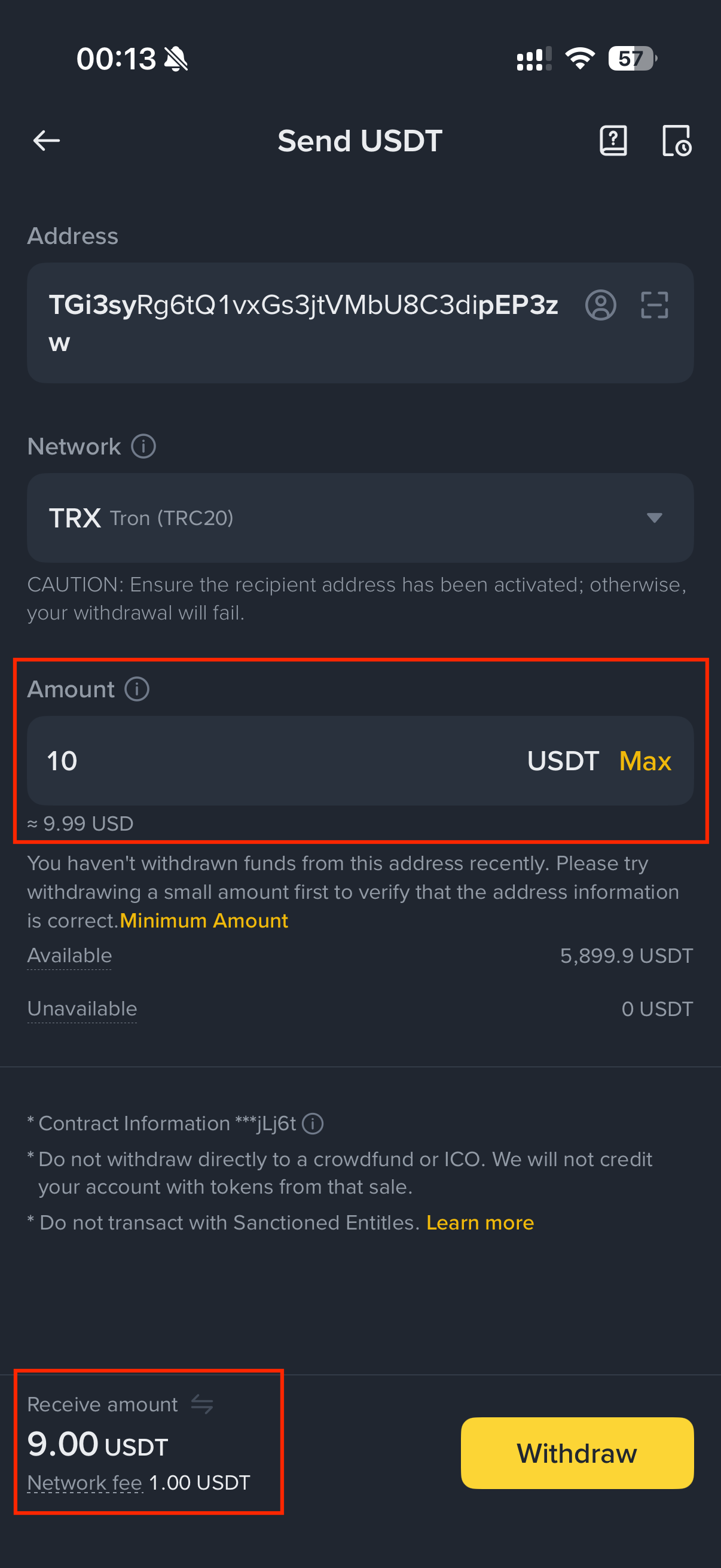 |
| MetaMask | No | - |
| Trust Wallet | No | - |
| Rainbow | No | - |
| Coinbase Wallet | No | - |
| OKX Wallet | No | - |
| TokenPocket | No | - |
| Phantom | No | - |
| Backpack | No | - |
| Solflare | No | - |
| Bitget Wallet | No | - |
| TronLink | No | - |
Recommendations
To ensure accurate payment amounts, it is recommended to:- Remind payers to be aware of internal deduction issues to ensure accurate payment amounts.
- Set reasonable order amount tolerance to allow underpayment within a certain range to handle possible internal fee deduction situations.